
Hot Takeaway Meals: Solving Disposable Wooden Cutlery Complaints
Hot food punishes disposable cutlery. Steam softens the surface, sauce adds load, and the customer is often eating one-handed out of a box. When a fork bends at the tines, a spoon edge leaves a splinter on the lip, or the utensil smells faintly of smoke, the complaint lands on the restaurant rather than on the packaging supplier. This guide diagnoses the four cutlery failures that damage hot-meal service and shows how certified disposable wooden cutlery from Greenwood resolves each one.

Bamboo and birch cutlery is specified by edge finish and heat resistance — the two variables behind most hot-meal complaints.
Cutlery complaints rarely arrive as a specification discussion. They arrive as a public review, a refund request, or a message on a delivery platform. Buyers who treat cutlery as a low-cost accessory usually discover the cost of that assumption during their first high-volume hot-meal season.
Problem Definition: The Four Complaints Hot-Meal Service Generates
Across restaurant, takeaway and catering operations, complaints about disposable cutlery cluster into four recognisable patterns. Each one traces back to a specification or process decision — not to the fact that the utensil is disposable.
- 1. Flimsy in use. Tines bend, handles bow, and forks snap when the customer lifts a load. Thin cross-sections, short handles and low-density raw material all reduce rigidity at exactly the moment heat and moisture are working against the utensil.
- 2. Burrs and rough edges. Incomplete edge finishing leaves fibres standing proud of the surface. In hot food those fibres soften rather than break away, so the customer notices a rough mouthfeel — or a splinter.
- 3. Odour and taste transfer. Poorly handled or stored raw material carries a smoky or musty smell that becomes more noticeable when it meets hot, aromatic food.
- 4. Heat and moisture deformation. Utensils that are not heat-resistant soften in steam, curl at the edges, or lose stiffness within minutes of contact with a hot container.
The buyer's takeaway: a complaint about “cheap” cutlery is almost always a complaint about an unspecified cutlery. Heat resistance, edge finish, handle length and material grade are the variables that decide whether a wooden utensil survives a hot meal — and all of them can be written into a purchase specification.
Industry Background: Why Cutlery Specification Is Now a Procurement Decision
Disposable wooden cutlery has moved from a niche compliance substitute to a mainstream category. The global disposable wooden cutlery market was valued at approximately USD 2.8 billion in 2025 and is projected to reach USD 5.2 billion by 2034, according to Dataintelo. Asia Pacific led the market in 2025 with a 38.6% share, supported by urbanisation and plastic restrictions in markets such as China and India.
Supply is concentrated. China remains the world's largest exporter of wood tableware and kitchenware under HS code 4419, with export values reaching approximately USD 1.38 billion to USD 1.5 billion in 2024, based on OEC and WITS trade data. Within the category, spoons are the largest product segment, accounting for roughly 32.5% to 47.2% of market share depending on the reporting agency, per Dataintelo and Future Market Insights.
Regulation is tightening around the material itself. The EU Deforestation Regulation (Regulation (EU) 2023/1115) requires geolocation and due-diligence documentation for wood products placed on the EU market, with the compliance timetable for large operators having been moved into the 2025–2026 window. Separately, wooden cutlery must meet EN 13432 to be legally marketed as “compostable” in the EU.
The practical consequence for buyers is that cutlery is no longer purchased on unit price alone. A cutlery line has to satisfy heat performance, edge quality, food-contact compliance and material traceability at the same time — and the supplier has to be able to document all four.
The Solution: What Certified Disposable Wooden Cutlery Changes
Greenwood — Greenwood - Dalian Industrial Co.,ltd., a disposable wooden tableware manufacturer founded in 2000 and based in Jinzhou, Dalian, China — produces wooden and bamboo cutlery built around exactly these failure points. The company operates five factories with an annual production capacity of 6 billion pieces, exports roughly 95% of its output, and holds BRC, FSC, FDA, LFGB, BSCI and ISO 9001 certifications.
Heat resistance that holds in hot food
Greenwood's wooden cutlery (model GW-20456) and bamboo cutlery (model GW-BC001) are both specified as heat-resistant and suitable for hot and cold food. That specification is the first line of defence against the softening and edge curling that generate complaints in steam-heavy takeaway formats — noodle boxes, curry trays, soup bowls and grill plates.
Smooth surfaces with no burrs
Both lines are finished to a smooth surface with no burrs. The bamboo specification describes a smooth edge with no burrs and a natural bamboo texture. In hot-meal service, edge finish is the difference between a utensil the customer never thinks about and a splinter-safety incident. Buyers sourcing splinter-free disposable wooden cutlery should ask for the edge-finish requirement in writing rather than judging from a product photograph, because the visible surface and the worked edge are not the same thing.
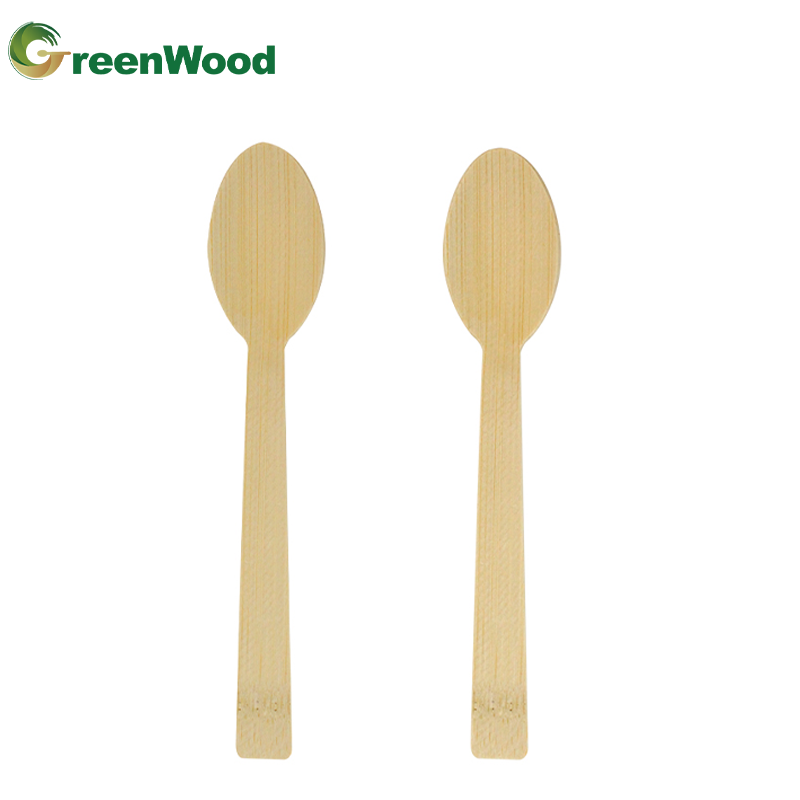
Edge finishing, not material alone, determines whether a wooden or bamboo utensil feels smooth in hot food service.
No smell, no taste transfer
The application specification for Greenwood tableware requires food-grade safety, no paint or wax, no odour, and compliance with food-contact standards. In practice this means raw-material handling and storage discipline matter as much as the wood species — which is why certifying the production process, not just the finished product, is worth verifying before a bulk order.
End-of-life: 100% biodegradable and compostable
Greenwood's wooden, bamboo and paper cutlery lines are specified as 100% biodegradable and compostable, which is what allows restaurant and takeaway operators to make disposal claims that match the packaging they already use. Buyers evaluating home compostable wooden cutlery claims in the EU should confirm which standard the claim was tested against; EN 13432 is the reference point for industrial compostability in that market.
A verifiable compliance stack
Compliance documentation is where cutlery sourcing most often stalls. Greenwood holds BRC, FSC, FDA, LFGB, BSCI and ISO 9001 certifications, and the bamboo cutlery specification lists LFGB and FDA conformity. For EU-facing buyers, FSC chain-of-custody documentation and geolocation records are the practical answer to EUDR due-diligence requests. Note that EUDR is a due-diligence regime rather than a product certificate, so a supplier's ability to produce documentation — not a logo on a catalogue page — is the thing to test.
Customisation for hot-meal brands
Greenwood runs OEM, ODM and customisation programmes covering logo printing on products and packaging, plus customised shapes and new designs. The wooden line is customisable by size, logo (laser or print) and packaging; the bamboo line supports hot-stamped logos, size, packaging and colour. For takeaway and restaurant brands, this is how a cutlery complaint becomes a brand touchpoint: the same utensil that survives a hot meal can also carry the logo, wrapped in individual packaging or bulk packing that matches the meal format.
Step-by-Step: Validating Wooden Cutlery for Hot-Meal Service
- Profile the meal, not the menu. List the hottest, heaviest and wettest dishes in the range — soup, curry, noodles, grilled protein. These set the thermal and load requirement for the whole cutlery order.
- Write the specification. Fix material (birch, poplar or bamboo), length and edge-finish requirement. Greenwood's wooden line covers 180mm, 170mm, 160mm, 140mm, 110mm and 95mm lengths with customisable sizes; the bamboo line runs a 170mm standard with 110mm, 140mm and 170mm options.
- Run a hot-meal trial, not a bench test. Test samples against the dishes identified in step one, ideally packed and held for the same duration as a real delivery order.
- Verify the compliance file. Request current certificates and confirm the documentation covers the specific product and production site. Greenwood holds BRC, FSC, FDA, LFGB, BSCI and ISO 9001 certifications.
- Confirm customisation and packaging format. Decide between bulk packing and individual packaging, and confirm the logo method — laser or print on wood, hot stamping on bamboo — against its lead-time impact.
- Lock volume, MOQ and lead time. Greenwood quotes an MOQ of 100,000 pieces with a 20-day lead time and a production capacity of 10 million pieces per day, which is the level at which a mid-season specification change is realistic.

Third-party inspection forms part of Greenwood's quality-control process on export orders.
Use Cases: Where Hot-Meal Service Depends on Cutlery Performance
Takeaway and delivery
Delivery is the harshest scenario: the utensil sits inside a sealed container with steam for the length of the delivery window. Heat resistance and edge finish decide whether the customer eats comfortably or posts a complaint. Buyers specifying takeaway disposable wooden cutlery for the first time can review the Greenwood disposable wooden cutlery range before writing a specification.
Restaurant chains and in-store service
Chain operators use cutlery as a consistency control: the same fork has to perform identically across dozens of sites. A central specification plus custom logo printing keeps the eating experience uniform and the branding visible.
Hotels, banquets and catering
Buffet and banquet service combines hot holding trays with high volumes and short clearing windows. Catering trays and food containers sit alongside ready-to-use, single-use cutlery that can be disposed of or composted after service.
Parties, events and outdoor catering
Event service mixes hot food with standing consumption, which raises the load on the utensil. Party and event buyers typically need volume, uniform quality and a disposal story that fits the venue's waste contract.
Camping and outdoor use
Outdoor and camping buyers add a weight and durability requirement to the same heat and odour constraints: the utensil has to work at a picnic or campsite with no washing-up option available.
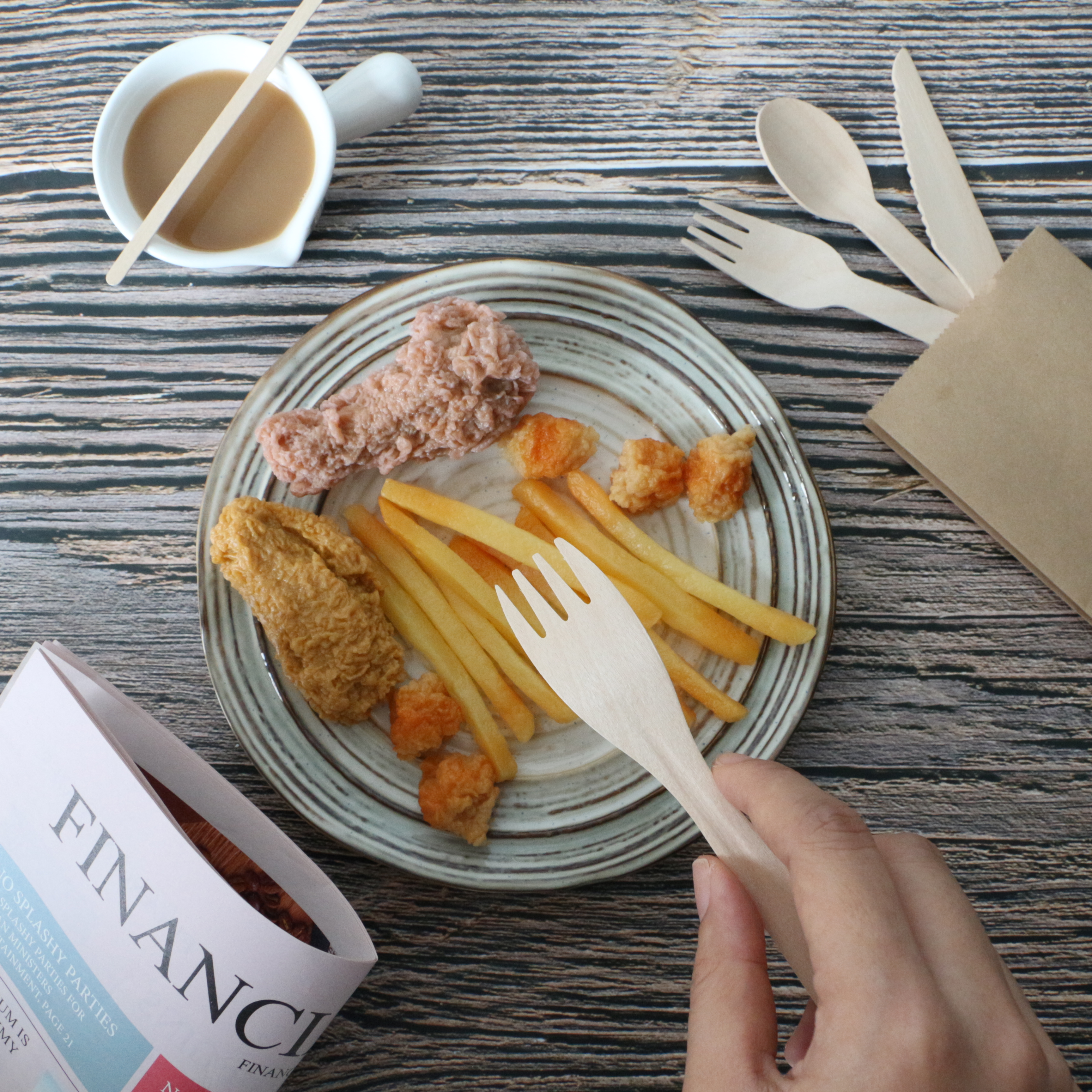
Hot takeaway service applies heat, moisture and load at the same time — the combination that exposes weak cutlery specifications.
Wholesale and bulk supply
Distributors and wholesale buyers need a manufacturer that can hold a specification across repeat orders. Greenwood operates five factories with an annual capacity of 6 billion pieces, holds warehouses in Bangladesh, Ukraine and the United States, and exports to Europe, ANZ, Canada, the USA, South America, the Middle East, Japan and Korea, and Southeast Asia. One reference case is a supermarket and chain-store customer in Germany and the United States with USD 5 million per year over three years, where eco-friendly tableware replaced traditional products and supported sales growth.
Comparison Table: Matching Greenwood Cutlery Lines to Hot-Meal Service
| Specification | Wooden cutlery — GW-20456 | Bamboo cutlery — GW-BC001 | Paper cutlery — GW-PC204 |
|---|---|---|---|
| Material | 100% natural wood (birch / poplar) | Sustainable bamboo | Paper |
| Standard lengths | 180 / 170 / 160 / 140 / 110 / 95 mm, customisable | 170 mm standard; 110 / 140 / 170 mm available | 158 mm standard, customisable |
| Suitability for hot & cold food | Yes — heat-resistant | Yes — heat-resistant, durable for takeaway & catering | Heat-resistant, waterproof & oil-proof |
| Surface / edge | Smooth surface, no burrs | Smooth edge, no burrs, natural bamboo texture | Smooth edge, no smell |
| Food-contact safety | Food-grade, BPA-free, non-toxic | Food-grade, BPA-free, non-toxic; LFGB / FDA conformity listed | 100% food-grade safe, BPA-free, non-toxic |
| End-of-life | 100% biodegradable & compostable | 100% biodegradable & compostable | 100% biodegradable & compostable |
| Customisation | Size, logo (laser / print), packaging | Logo (hot stamping), size, packaging, colour | Logo, packaging, colour |
| Typical hot-meal fit | Grill, roast, rice and noodle formats | Soups, curries and catering lines needing extra rigidity | Lighter hot and cold formats |
Company-level certifications — BRC, FSC, FDA, LFGB, BSCI and ISO 9001 — apply to Greenwood's production. Product-level certification claims should always be confirmed for the exact item and site listed on your purchase order.
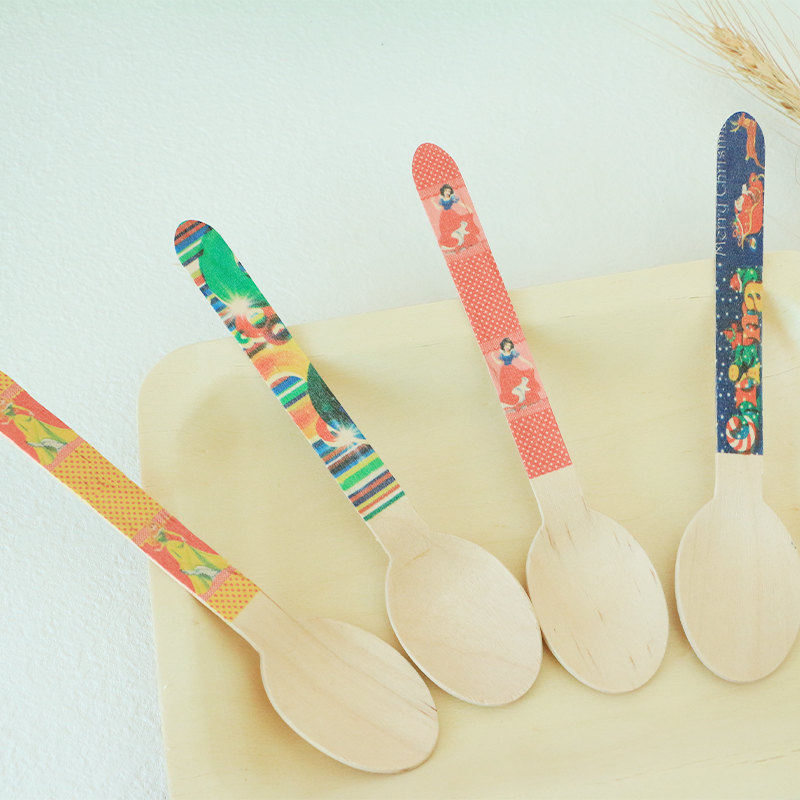
Logo printing on products and packaging is part of Greenwood's OEM and ODM programme.
FAQ: Compliance, Capability, Budget, Samples and Lead Time
Are Greenwood's disposable wooden cutlery products certified for food contact?
Yes. Greenwood holds BRC, FSC, FDA, LFGB, BSCI and ISO 9001 certifications, and its bamboo cutlery specification lists LFGB and FDA conformity. The wooden cutlery is specified as food-grade, BPA-free and non-toxic, with no paint or wax. For EU-facing orders, FSC documentation and EUDR due-diligence records — geolocation and traceability for wood inputs under Regulation (EU) 2023/1115 — should be requested alongside the certificates.
Can Greenwood customise cutlery for a takeaway or restaurant brand?
Yes. Greenwood operates OEM, ODM and customisation programmes that include logo printing on products and packaging, plus customised shapes and new designs. The wooden line can be customised by size, logo (laser or print) and packaging; the bamboo line supports hot-stamped logos, size, packaging and colour. A nine-engineer R&D team supports design changes, and the after-sales scope covers packaging design and logistics support.
What is the minimum order quantity and how is pricing structured?
Greenwood's stated MOQ is 100,000 pieces, with production capacity of 10 million pieces per day across five factories and annual output of 6 billion pieces. Pricing depends on material, length, customisation and packaging format, so it is quoted per project rather than published as a list — buyers should share the meal profile and packaging requirement to receive an accurate quotation.
Can we test samples before committing to a bulk order?
Yes. Sample evaluation is the practical way to confirm heat resistance, edge finish and odour performance against your own hot dishes before a bulk commitment. Testing the actual hottest dish in your range, held for the length of a real delivery window, tells you more than a bench comparison. Third-party inspection is available as part of Greenwood's quality control on export orders.
What is the lead time for a customised order?
Greenwood quotes a 20-day lead time. With a production capacity of 10 million pieces per day and warehouses in Bangladesh, Ukraine and the United States serving Europe, ANZ, Canada, the USA, South America, the Middle East, Japan and Korea, and Southeast Asia, the schedule holds for repeat programmes as well as first orders. The practical next step is to share your specification and volumes so the lead time can be confirmed against your delivery calendar.
Conclusion: Fix the Specification, Not the Complaint
Cutlery complaints in hot-meal service are predictable, because the conditions that cause them are predictable: heat, moisture, load and time. Heat-resistant wooden and bamboo cutlery with a smooth, burr-free edge, no smell, and a 100% biodegradable and compostable end-of-life addresses all four conditions directly — and when it is backed by BRC, FSC, FDA, LFGB, BSCI and ISO 9001 certification plus OEM customisation, the same utensil can also carry your branding.
The buyers who stop receiving complaints are the ones who specified edge finish, length and heat performance before the order, not after the review. That specification work is a single conversation with the manufacturer.
Request a Sample or Quotation
Send your hot-meal profile, target volumes and packaging requirement to ireenwang@caregreenwood.com, or reach the team on WhatsApp 008613840907153. Samples and a full specification sheet are available on request.
Download the Greenwood product catalogue (PDF) for the full cutlery range, or visit woodencutlery.cn. Greenwood - Dalian Industrial Co.,ltd., Jinzhou, Dalian, China — Tel: 008613840907153.
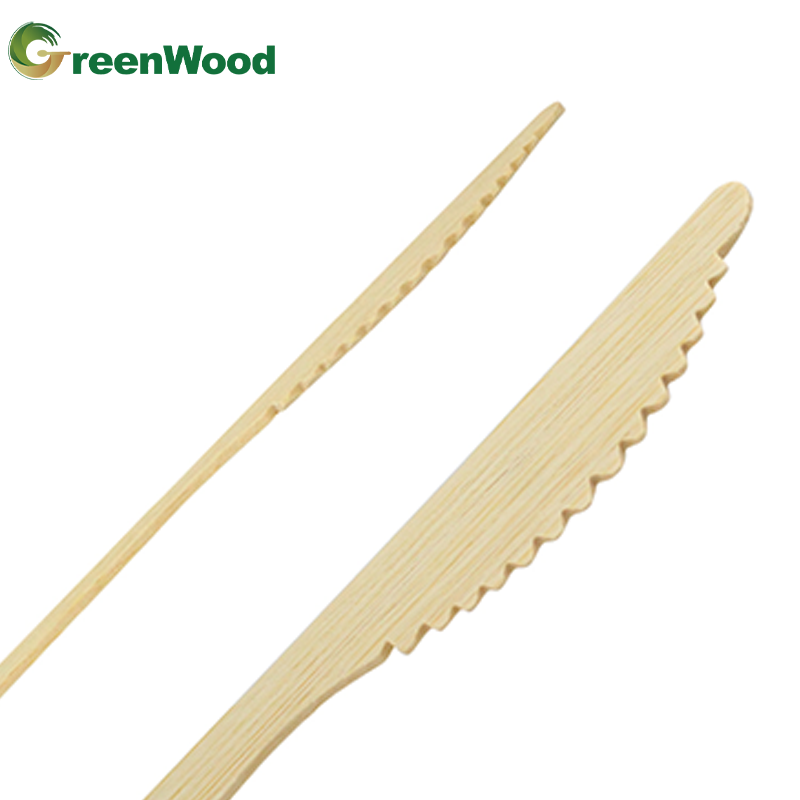
Sample kits and bulk quotation are available for takeaway, catering and wholesale buyers.
Have Questions or Need More Details?
Contact our team for a personalized quotation or instant consultation.
Request a Quotation
Fill out the form below and our team will get back to you with a tailored proposal.
WhatsApp Direct Chat
Prefer to chat in real-time? Message us on WhatsApp for instant assistance & quick answers.
- Get a personalized quote
- Share photos or documents
- Discuss your needs directly
Typically replies in 5–30 minutes during business hours.