
Disposable Bamboo Cutlery: A Buyer's Guide to Sourcing from China
Disposable Bamboo Cutlery: A Buyer's Guide to Sourcing from China

Disposable bamboo cutlery is single-use tableware — knives, forks, spoons, stirrers and skewers — made from bamboo rather than plastic, paper or wood. It is one of the material options buyers now compare when a restaurant chain, takeaway operator, retailer or airline caterer needs food-contact tableware that can be described as biodegradable and compostable without giving up the practical requirements of daily service.
This guide answers the question buyers actually ask at the start of a sourcing project: what should I check before I request a quote from a Chinese disposable bamboo cutlery manufacturer? It is written for the awareness and research stage, where the product category is understood but the specification, the compliance evidence and the supplier shortlist are not yet defined.
Greenwood - Dalian Industrial Co.,ltd. is a Chinese manufacturer of disposable wooden and bamboo tableware, founded in 2000 and based in Jinzhou, Dalian, China, operating five factories and exporting roughly 95% of its output to markets including Europe, North America, South America, the Middle East, Japan and Korea, and Southeast Asia. Its bamboo range is used in this article as a reference point for what a documented, specifiable bamboo cutlery product looks like.
The Real Sourcing Problem Behind Disposable Bamboo Cutlery
The difficulty is rarely finding suppliers. A search for bamboo cutlery manufacturers returns hundreds of companies, and most of them use the same vocabulary: eco-friendly, biodegradable, food-grade, custom logo. The difficulty is that this vocabulary does not separate four different questions that have four different answers.
- Material fitness. Does bamboo cutlery actually perform in this service format — hot food, cold food, delivery, catering, retail shelf?
- Compliance evidence. Can the supplier support the food-contact and material claims with documentation that matches the exact item being quoted?
- Customization depth. Is branding and packaging a supported option, or a claim on a landing page?
- Supply reliability. Can the supplier hold a specification across repeat orders and across markets?
Buyers who treat these as one question tend to make one of two mistakes. They either select on price alone and discover a specification gap at the sample stage, or they over-specify at the research stage and exclude suppliers who could have met the real requirement at a better total cost. The practical approach is to define the service format first, then test suppliers against documented capability.
Key distinction: a product page that says "eco-friendly" is marketing language. A specification sheet that states material, length, food-contact certification and packaging format is procurement information. Only the second one can be quoted, repeated and audited.
Industry Background: Why Bamboo Became a Standard Cutlery Material
Disposable cutlery has moved from a single-material category to a multi-material one. Wood, bamboo and paper are now compared side by side for the same foodservice jobs, and buyers increasingly ask for material documentation rather than a sustainability slogan.
Bamboo sits in an interesting position in that comparison. It is a grass rather than a timber species, and it is widely described as a fast-renewing material, which is why it is often grouped with wood in appearance but discussed separately in sustainability terms. In cutlery form it produces a rigid, lightweight utensil with a natural surface texture — closer to wooden cutlery in handling than to moulded paper or plastic alternatives.
Demand has also shifted because operator requirements have shifted. A takeaway cutlery item is no longer judged only on cost per piece. It is judged on whether it survives a hot dish in a sealed container, whether the edge is smooth enough for a customer to use without complaint, whether it can carry a brand, and whether it can be described accurately on a menu, a delivery platform or a retail pack.
That last point matters more than it appears. Sustainability claims have become a compliance topic as well as a marketing topic in many markets, so the wording a supplier can legitimately support — biodegradable, compostable, food-grade, LFGB-tested, FDA-compliant — should be confirmed before it appears on packaging. A manufacturer that can evidence its claims is worth more to a buyer than one that simply repeats them.
Detailed Solution: What a Documented Bamboo Cutlery Range Contains
The reference product for this guide is Greenwood's disposable bamboo cutlery, model GW-BC001. It is a single-use bamboo range covering bamboo knives, bamboo forks, bamboo spoons, bamboo coffee stirrers and bamboo skewer sticks, produced for restaurant chains, supermarkets, takeaway wholesalers and airline catering, as well as for eco-friendly and sustainable product programmes.
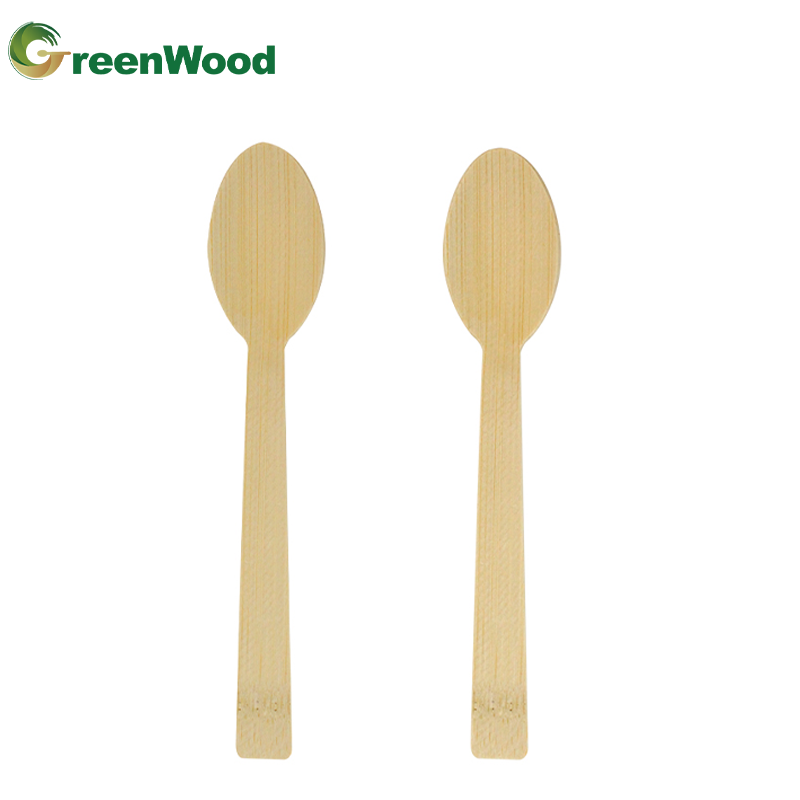
The published specification for the range is the part worth reading closely, because it answers most of the questions a buyer would otherwise send by email:
- Standard length: 170 mm, with 110 mm and 140 mm also available and other sizes customizable.
- Material: sustainable bamboo.
- Food-contact statement: 100% food-grade safe, BPA-free and non-toxic, LFGB and FDA certified.
- End-of-life statement: 100% biodegradable and compostable.
- Handling characteristics: heat-resistant, smooth edge, no burrs, natural bamboo texture, suitable for hot and cold food, and described by the manufacturer as durable for takeaway and catering use.
- Customization: logo by hot stamping, plus customizable size, packaging and colour.
Behind the product: production and export capability
Specification alone does not answer the supply question, so the manufacturer profile matters as well. Greenwood was founded in 2000 and describes more than 20 years of industry experience in disposable wooden tableware. The company operates five major factories with an annual production capacity of 6 billion pieces across a chain that runs from raw material procurement through production and processing to finished product packaging. It employs around 500 people and maintains a 9-engineer R&D team.
Its certifications are listed as BRC, FSC, FDA, LFGB, BSCI and ISO9001 — a combination that covers food safety, quality management and social compliance rather than a single marketing claim. The company also holds warehouses in Bangladesh, Ukraine and the United States, which supports order handling for Europe, North America, South America and the Middle East. For buyers, the relevant point is not the list itself but the fact that compliance, capacity and customization are documented in the same place as the product specification.

The knife, fork and spoon formats
Format is a purchasing decision, not a detail. A bamboo knife needs a different profile from a bamboo spoon, and a fork used for a takeaway salad has different requirements from a fork supplied to an airline tray. Within the GW-BC001 range the knife, fork and spoon are treated as separate items with a shared material specification, which allows a buyer to build a set — or order single items — without mixing suppliers.

Skewers and food sticks
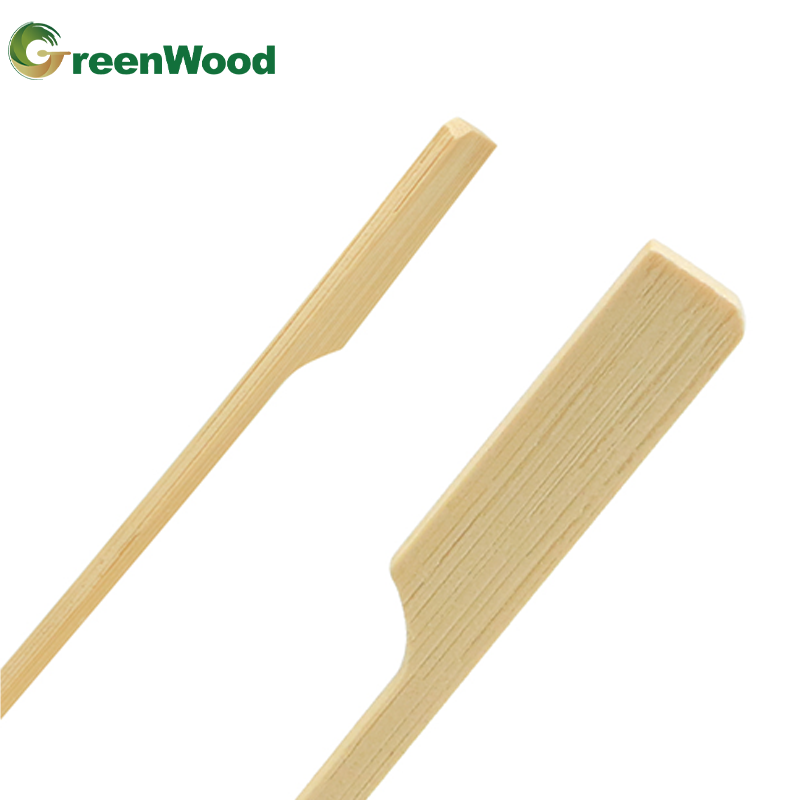
The same bamboo material is also supplied as bamboo skewer sticks. This matters for buyers who purchase across more than one category: BBQ skewers, food sticks for catering and skewers used in prepared food can often be sourced from the same manufacturer as the cutlery, which simplifies documentation, consolidates shipping and reduces the number of supplier audits a purchasing team has to manage.
Step-by-Step: How to Evaluate Disposable Bamboo Cutlery Suppliers
The sequence below is written for a first-time or repeat buyer who has decided on bamboo as the material but has not yet fixed a specification. Each step ends with a decision that can be documented.
Step 1 — Define the service format before the product
Write down where the cutlery will be used: dine-in restaurant service, delivery and takeaway, airline catering, retail shelf, outdoor catering, banquet or exhibition. The corpus scenario data for this category describes ambient-temperature food contact in indoor and outdoor environments, single-use manual handling, and pairing with food containers, takeaway boxes, packaging trays and catering trays. That pairing often determines whether a loose item or an individually wrapped item is the right format.
Step 2 — Confirm food-contact documentation for the exact item
Ask for the certification that applies to the specific product being quoted, not to the supplier's general range. For the bamboo range in this guide, the stated position is 100% food-grade safe, BPA-free, non-toxic, LFGB and FDA certified. The company-level certifications — BRC, FSC, FDA, LFGB, BSCI, ISO9001 — provide the second layer. Both layers should match the item, the material and the packaging you intend to buy.
Step 3 — Match length and format to the menu
Length affects handling more than buyers expect. The 170 mm bamboo format is the standard reference length, with 110 mm and 140 mm also available in the range. Shorter formats suit desserts, coffee service and children's menus; longer formats suit main dishes and catering trays. Confirm whether the cutlery will be used with hot food, cold food or both, since the range is specified for both.
Step 4 — Decide whether branding and packaging are part of the product
Custom logo bamboo cutlery is a packaging and production decision, not a Photoshop decision. The GW-BC001 range supports hot-stamping logos and customizable size, packaging and colour, and the manufacturer also offers customized printing and individual packaging services. Decide at this stage whether you need individually wrapped bamboo cutlery, a paper sleeve, a printed box, or retail-packaged bamboo cutlery sets for supermarket listings — because each option changes the production route and the artwork deadline.
Step 5 — Validate with samples before committing
Samples are where a specification becomes real. Check the edge for burrs, the surface for the stated natural bamboo texture, the behaviour with hot food, and the print quality if a logo is involved. Compare the sample against the written specification line by line, and keep the approved sample as the reference for the bulk order.
Step 6 — Check capacity and continuity
A quotation is only useful if it can be repeated. Five factories, an annual production capacity of 6 billion pieces, and warehouses in Bangladesh, Ukraine and the United States are the kind of operational facts that indicate whether a supplier can support volume orders and long-term cooperation. Ask how the supplier plans repeat orders and how it handles specification consistency between production runs.
Step 7 — Plan logistics, documentation and the reorder cycle
Confirm what accompanies the shipment: certification copies, specification sheets, packaging artwork approvals and the commercial documents required by the destination market. Because the manufacturer exports to Europe, ANZ, Canada, the USA, South America, the Middle East, Japan and Korea, and Southeast Asia, buyers should state the destination market at the quotation stage rather than at the shipping stage.
Use Cases: Where Disposable Bamboo Cutlery Fits in Real Operations
Bamboo cutlery is not a universal replacement for every disposable format. It performs best where a rigid utensil, a natural material story and a food-contact specification all matter at the same time.
Restaurant chains and multi-site foodservice
Chains need a specification that can be replicated across sites and reordered without variation. Bamboo knives, forks and spoons in a fixed format, supported by certification documentation, allow a central procurement team to hold one standard across locations.
Takeaway and delivery
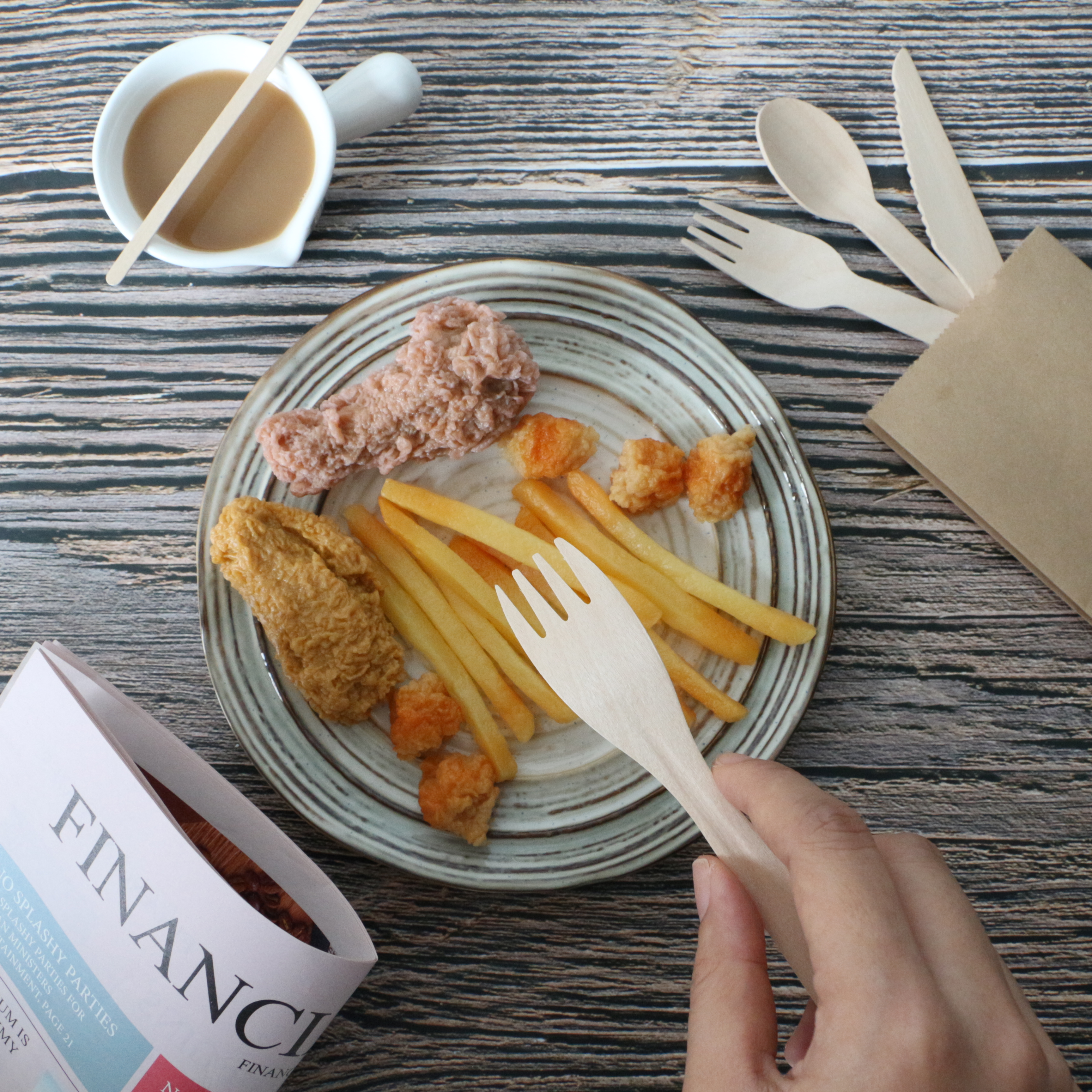
Delivery is the hardest environment for disposable cutlery: heat, moisture and time in a sealed container. The bamboo range is specified as heat-resistant and suitable for hot and cold food, and it pairs with takeaway boxes, food containers and packaging trays. Individually wrapped bamboo cutlery is the usual choice where hygiene perception matters to the end customer.
Airline catering
Airline catering is listed among the intended industries for this range. It is a specification-driven environment where weight, packaging format and documentation usually matter more than unit cost, and where individually wrapped items are common.
Supermarkets and retail-packaged sets
Retail is a different product from foodservice. Retail-packaged bamboo cutlery sets require printed packaging, barcode-ready artwork and a finish that survives shelf handling. Custom logo bamboo cutlery and custom packaging are the relevant capabilities here, and the ability to produce a consistent set — knife, fork, spoon, sometimes a stirrer — from one supplier simplifies the listing process.
Outdoor catering, banquets and events
Picnics, banquets, exhibitions and outdoor catering are explicitly covered by the scenario data for this category, which describes indoor and outdoor environments at ambient temperature. Bamboo works well visually in these settings, where the material appearance is part of the guest experience.
Coffee service, stirrers and skewers
Coffee stirrers and bamboo skewers extend the same material platform into beverage service, BBQ and prepared food. Buyers sourcing several disposable items can often consolidate them into one order and one documentation set.
Bamboo vs Wooden vs Paper Cutlery: A Like-for-Like Comparison
The three disposable cutlery materials quoted by the same manufacturer can be compared directly on published specification, which is more useful than comparing marketing pages from different suppliers. The table below uses only stated product data; it does not rank the materials, because the right choice depends on the service format.
| Attribute | Bamboo — GW-BC001 | Wooden — GW-20456 | Paper — GW-PC204 |
|---|---|---|---|
| Material | Bamboo | Wood, bamboo | Paper |
| Standard length | 170 mm | 170 mm / 180 mm / 160 mm / 140 mm / 110 mm / 95 mm | 158 mm |
| Formats in range | Bamboo knife, fork, spoon, coffee stirrer, skewer sticks | Wooden knife, fork, spoon, ice cream stick, coffee stirrer | Paper knife, fork, spoon |
| Food-contact statement | 100% food-grade safe, BPA-free, non-toxic; LFGB / FDA certified | Food-grade, BPA-free, non-toxic | 100% food-grade safe, BPA-free, non-toxic |
| End-of-life statement | 100% biodegradable and compostable | 100% biodegradable and compostable | 100% biodegradable and compostable |
| Handling notes | Heat-resistant, smooth edge, no burrs, natural bamboo texture, suitable for hot and cold food | Smooth surface, no burrs, heat-resistant, suitable for hot and cold food | Heat-resistant, waterproof and oil-proof, smooth edge, no smell |
| Customization | Logo by hot stamping; size, packaging and colour | Size, logo by laser or print, packaging | Logo, packaging and colour |
| Typical fit | Foodservice, takeaway, airline catering, retail sets, events | Foodservice, ice cream and dessert, coffee service | Light-service foodservice, takeaway and retail where a lighter utensil suits the menu |
Two conclusions follow from the table. First, the material claims overlap more than buyers expect — all three are stated as biodegradable and compostable — so differentiation usually comes from handling, format range and customization rather than from the sustainability word itself. Second, the bamboo range is the one that states LFGB and FDA certification against the product specification, which is the detail a compliance-driven buyer will ask about first.
Frequently Asked Questions
Are Chinese disposable bamboo cutlery manufacturers able to supply LFGB- and FDA-compliant products?
Yes, when the manufacturer holds the documentation for the specific item. Greenwood's bamboo cutlery, model GW-BC001, is specified as 100% food-grade safe, BPA-free and non-toxic, and LFGB and FDA certified. At company level, Greenwood lists BRC, FSC, FDA, LFGB, BSCI and ISO9001. Buyers should ask for the certificate that matches the exact product, material and packaging being quoted, not only the company certificate set.
Can a Chinese bamboo cutlery manufacturer produce custom logo and packaging?
Customization is a standard capability in the GW-BC001 range: logo by hot stamping, plus customizable size, packaging and colour. Greenwood also provides customized printing and individual packaging services, which covers individually wrapped bamboo cutlery, printed sleeves and retail-packaged sets. The practical requirement is to confirm the logo method, the packaging format and the artwork approval step before production, because each option changes the production route.
What sizes and formats of disposable bamboo cutlery can be ordered?
The standard length is 170 mm, with 110 mm and 140 mm also available in the range, and other sizes customizable. Formats include bamboo knives, forks, spoons, coffee stirrers and skewer sticks, so a buyer can build a knife-fork-spoon set, a takeaway set, a coffee-service item or a BBQ skewer order from the same material platform. The range is specified for both hot and cold food.
How should a buyer validate quality before placing a bulk order?
Validate against the written specification rather than against a photograph. Request samples of the exact format and length, check the edge for burrs, confirm the natural bamboo texture and surface finish, test performance with the hot or cold dishes you actually serve, and verify any printed logo. Then request the certification documents for the same item and keep the approved sample as the reference standard for the bulk production run.
How large is the supply capacity behind a Chinese bamboo cutlery quotation?
Capacity varies by manufacturer, so it should be checked as a documented fact. Greenwood was founded in 2000, operates five major factories with an annual production capacity of 6 billion pieces, employs around 500 people and maintains a 9-engineer R&D team. The company also holds warehouses in Bangladesh, Ukraine and the United States and exports about 95% of its output, which supports volume orders and long-term cooperation rather than one-off purchases.
Conclusion
Disposable bamboo cutlery is a mature, specifiable product category, and the sourcing decision is won or lost on documentation rather than on adjectives. The buyers who get a reliable result are the ones who define the service format first, confirm food-contact certification for the exact item, fix the length and packaging format, validate with samples, and check capacity before committing to volume.
Greenwood's GW-BC001 range is a useful benchmark for that process: a stated standard length of 170 mm with 110 mm and 140 mm alternatives, a food-grade, BPA-free and non-toxic specification with LFGB and FDA certification, 100% biodegradable and compostable material, hot-stamped logo customization, and production backed by five factories, a 9-engineer R&D team and warehouses in three regions. Whether or not it is the final choice, it provides a comparison standard against which other quotations can be measured.
Next Step: Samples, Specification and Quotation
If you are shortlisting suppliers for disposable bamboo cutlery, the fastest way to move from research to a decision is to request the product specification, the certification documents and a sample of the format you intend to order.
Download the full product catalogue: Greenwood product brochure (PDF)
Contact for samples and quotation:
Irene Wang — ireenwang@caregreenwood.com
Tel / WhatsApp: 0086 138 4090 7153
Address: Jinzhou, Dalian, China
Website: www.woodencutlery.cn
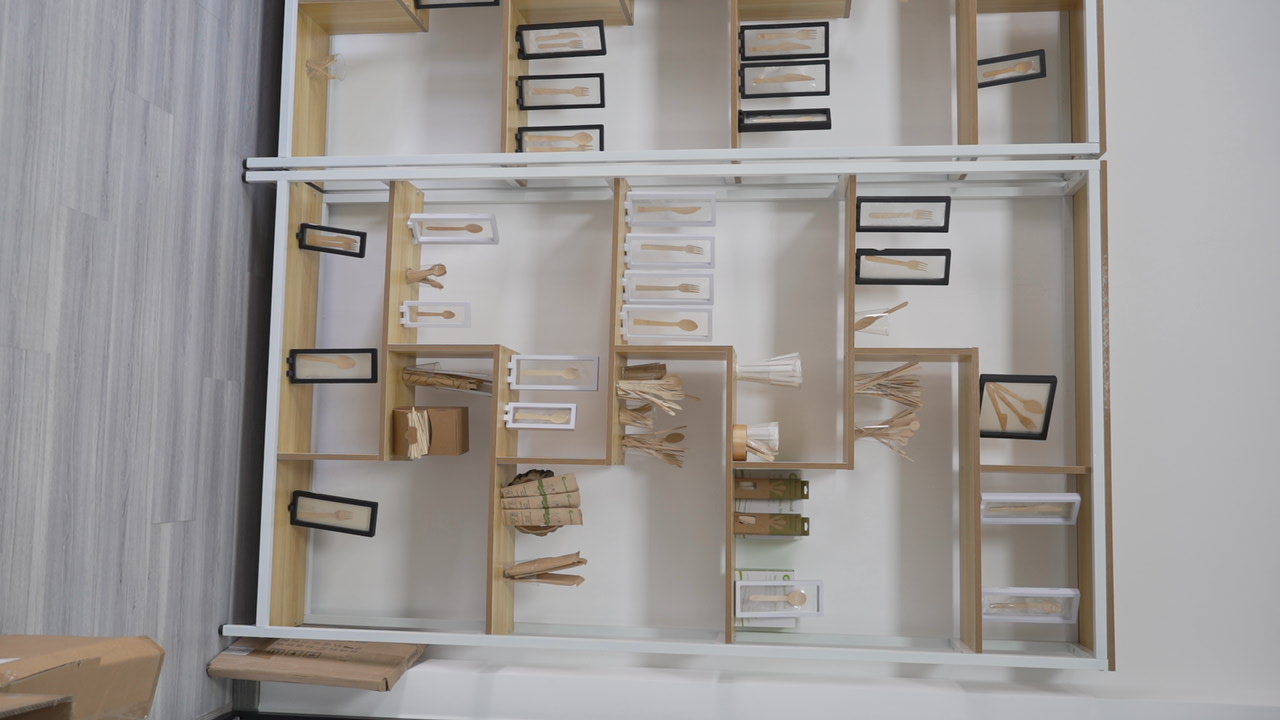
Greenwood - Dalian Industrial Co.,ltd. — manufacturer of disposable wooden and bamboo tableware since 2000.
Have Questions or Need More Details?
Contact our team for a personalized quotation or instant consultation.
Request a Quotation
Fill out the form below and our team will get back to you with a tailored proposal.
WhatsApp Direct Chat
Prefer to chat in real-time? Message us on WhatsApp for instant assistance & quick answers.
- Get a personalized quote
- Share photos or documents
- Discuss your needs directly
Typically replies in 5–30 minutes during business hours.