
Disposable Wooden Cutlery Dimensions & Surface Finish Guide
Disposable Wooden Cutlery Dimensions & Surface Finish Guide
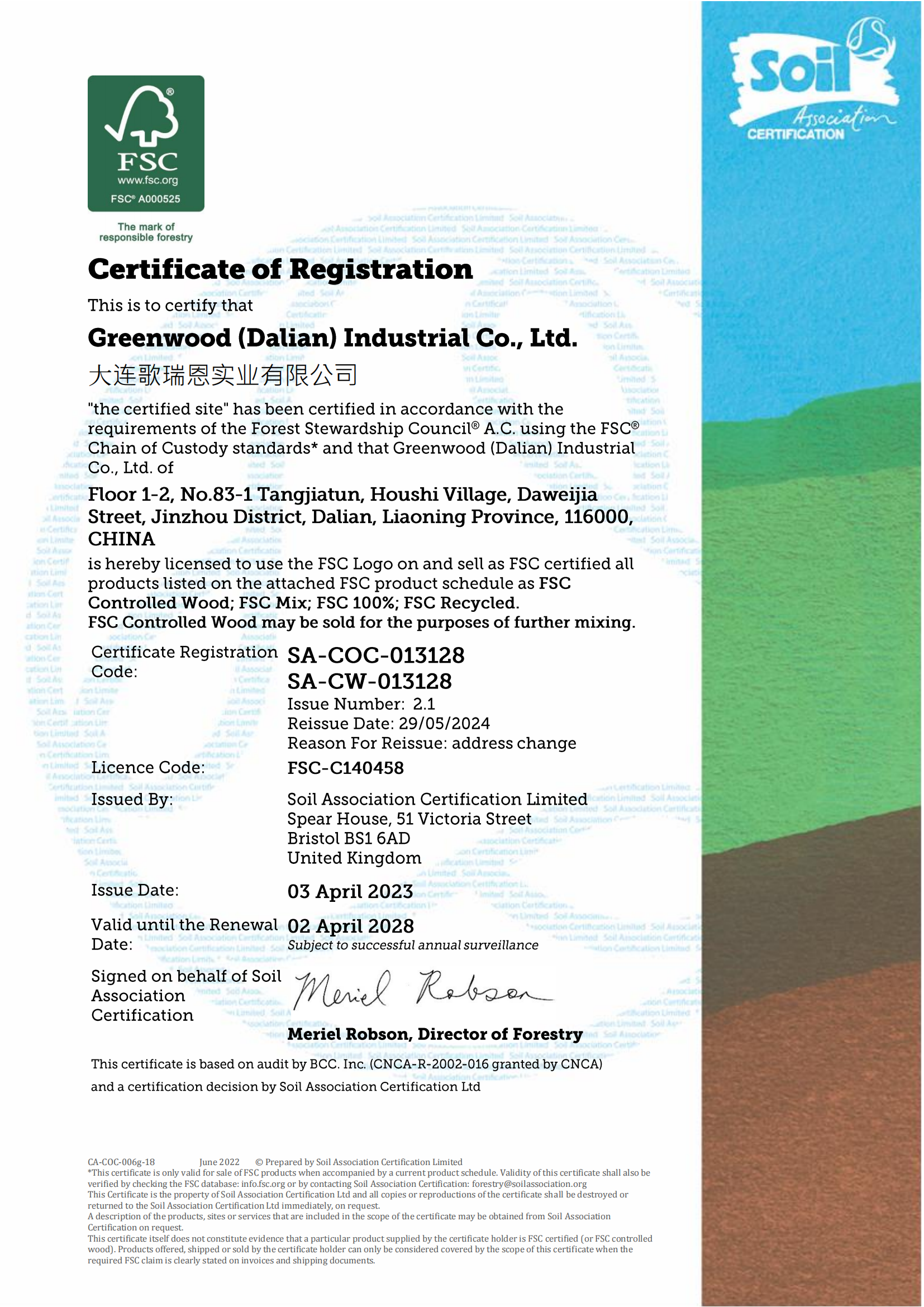
Two parameters decide whether a wooden cutlery delivery passes inbound inspection: overall length and the condition of the edges and surface. Material and certification matter, but a container of cutlery that is 5 mm off the specified length, or that leaves a splinter in a customer's hand, is a failed delivery regardless of how sustainable the raw material is. This guide works through both parameters using one concrete specification family — GW-20456 from Greenwood – Dalian Industrial Co.,ltd., a disposable wooden tableware manufacturer founded in 2000 — which is offered in six lengths: 180 mm, 170 mm, 160 mm, 140 mm, 110 mm and 95 mm, with a stated smooth surface, no burrs, and heat resistance suitable for hot and cold food. Production control for that specification is backed by an FSC Chain of Custody certificate (SA-COC-013128) and an ISO 9001 certificate (02024E1883R0M) covering wooden product manufacturing.
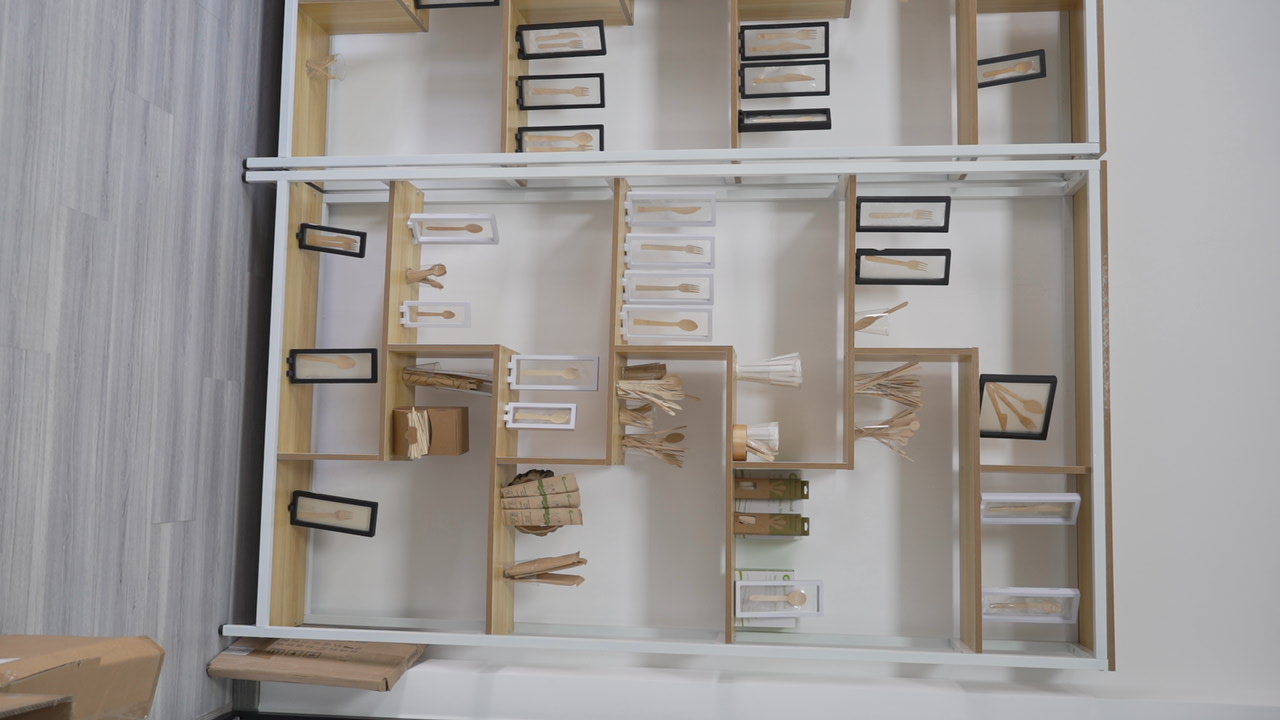
Why Length and Edge Condition Decide Whether a Specification Holds
A cutlery specification fails in a predictable way. It is not usually the material that triggers a claim; it is the geometry.
Length is a fit parameter, not a cosmetic one. If the specified length is shorter than the meal format requires, the cutlery under-performs in use. If it is longer than the packaging or the wrapped set allows, the cutlery either will not fit the wrap or protrudes and punctures it. Both failures appear after purchase, at the point of use, which is the most expensive place to discover a specification error.
Edge and surface condition behaves the same way. The specification wording smooth surface, no burrs is an acceptance criterion, and it only has value if it is tied to something measurable at goods-in. A supplier that treats it as a marketing line will produce batches where the criterion is unmet but undetectable until a diner handles the item.
Failure conditions to design out at the specification stage
- Length mismatch against the meal format. Long-format meals and short-format snacks do not resolve to the same cutlery length.
- Length mismatch against packaging. Wrapped and individually wrapped sets have a fixed internal cavity; cutlery that exceeds it damages the wrap.
- Edge roughness. A visible or tactile burr converts a sustainability purchase into a handling complaint.
- Surface change introduced by branding. Logo application is a surface process; if it is specified after the finish, it can compromise the finish.
- Heat performance claimed but not documented. Hot-food suitability needs a food-contact document trail, not a verbal assurance.
Category Context: From "Eco" to "Specified"
Disposable wooden cutlery has moved from a niche substitution product to a specified commodity line. Published market estimates put the global disposable wooden cutlery market at approximately USD 2.8 billion in 2025, with a projection of USD 5.2 billion by 2034 (Dataintelo). Estimates diverge widely depending on whether non-disposable wooden cutlery is included — a broader "wooden cutlery" scope has been reported at a far higher order of magnitude — so buyers should treat any single figure as a directional indicator rather than a procurement input.
Supply concentration is the more practical signal. Asia Pacific accounted for 38.6% of the global market in 2025 (Dataintelo), and China remains the world's largest exporter of wood tableware and kitchenware under HS 4419, with export values of roughly USD 1.38–1.5 billion in 2024 (OEC / WITS). Within the product mix, spoons are the largest single segment, reported at 32.5%–47.2% of market share depending on the reporting agency (Dataintelo / Future Market Insights).
Two regulatory threads now sit directly on top of the specification:
- EUDR — Regulation (EU) 2023/1115. The EU Deforestation Regulation requires geolocation and due-diligence evidence for wood products. The compliance deadline for large operators has been postponed, with the latest council agreements pointing to December 2026 (European Commission). Chain-of-custody certification is the working mechanism most suppliers use to support that due-diligence file.
- EN 13432. In the EU, wooden cutlery must meet EN 13432 (industrial compostability) to be legally marketed as "compostable" (European Standards). A "100% biodegradable and compostable" product specification and a legally usable compostability claim are therefore two different things, and the claim wording should be checked against the applicable certificate.
The practical consequence is that a wooden cutlery line is now evaluated on documented dimensional and surface control, not on the eco descriptor alone.
The GW-20456 Dimension Set: Six Lengths in One Specification Family
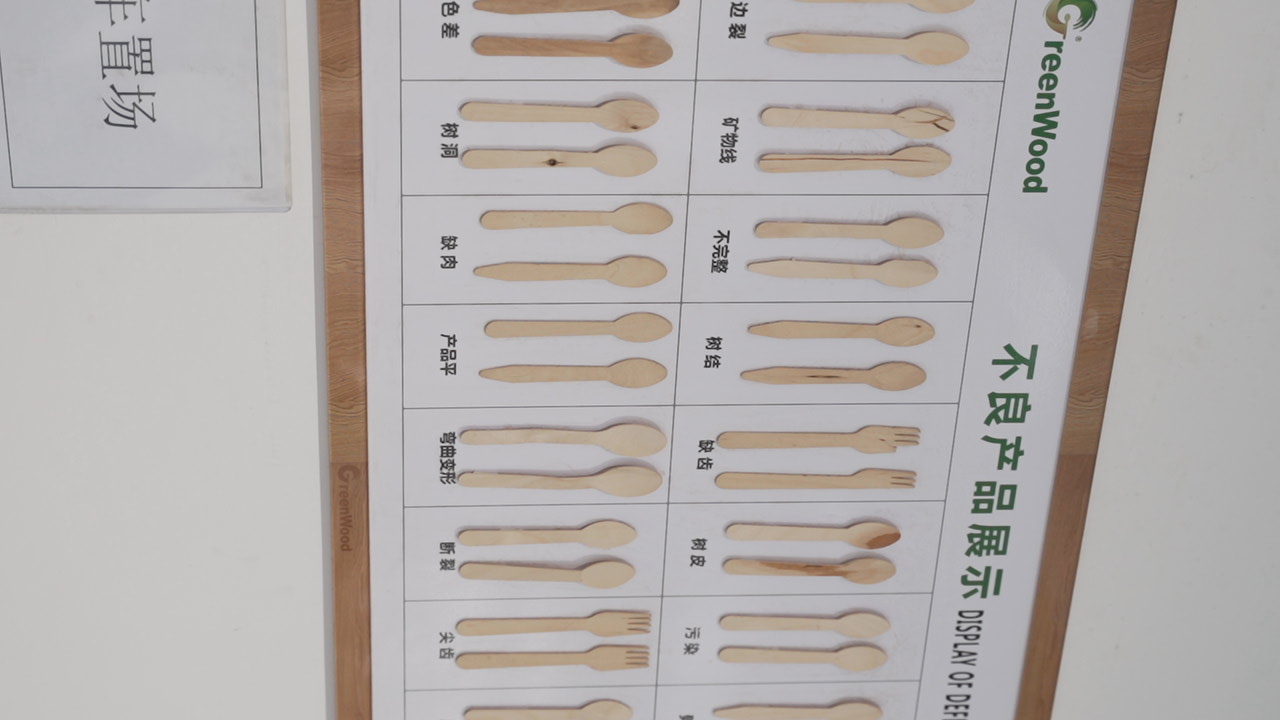
GW-20456 is the disposable wooden cutlery reference covered here. It covers wooden knives, forks and spoons, ice cream sticks and coffee stirrers, and it is offered across six lengths with custom sizes available on request.
| Specification parameter | GW-20456 |
|---|---|
| Available lengths | 180 mm / 170 mm / 160 mm / 140 mm / 110 mm / 95 mm (customizable sizes) |
| Product types in the range | Wooden knife, wooden fork, wooden spoon, ice cream stick, coffee stirrer |
| Material | 100% natural wood (birch / poplar) |
| Safety attributes | Food-grade, BPA-free, non-toxic |
| Surface and edge | Smooth surface, no burrs |
| Thermal suitability | Heat-resistant; suitable for hot and cold food |
| End of life | 100% biodegradable & compostable |
| Customization | Size, logo (laser / print), packaging |
| Typical application | Restaurant chains, supermarkets, takeaway wholesalers, airlines |
The value of a six-length range is consolidation. A buyer running several service formats — dine-in, takeaway, catering — can hold one supplier, one certification file and one quality standard while covering several length requirements, instead of splitting the specification across multiple suppliers with different control systems. Where the standard lengths do not fit an existing packaging format, the size is listed as customizable, which means the conversation moves to tooling and sampling rather than to a supplier change.
Surface Finish: Converting "No Burrs" Into an Acceptance Criterion
The GW-20456 specification states a smooth surface with no burrs. In a sourcing document, that should be restated as three checkable conditions:
- Visual: no raised fibres, splinters or torn grain visible on edges, tines or bowl rims.
- Tactile: no roughness detectable by hand along the full length of the edge.
- Consistency: the condition holds across the batch, not only on the sample.
Material selection sets the baseline. Birch and poplar are the woods used in the Greenwood range, and both take a clean cut and a settled surface more predictably than dense, interlocked grain species. From there, surface consistency is a quality-management output rather than a single machine setting: it is the part of production that the ISO 9001 system is designed to hold stable across batches. That is the reason the certificate scope matters — the ISO 9001 certificate covers wooden product manufacturing as a system, so it speaks to repeatability, not to one inspection event.
Why logo method belongs in the surface-finish discussion
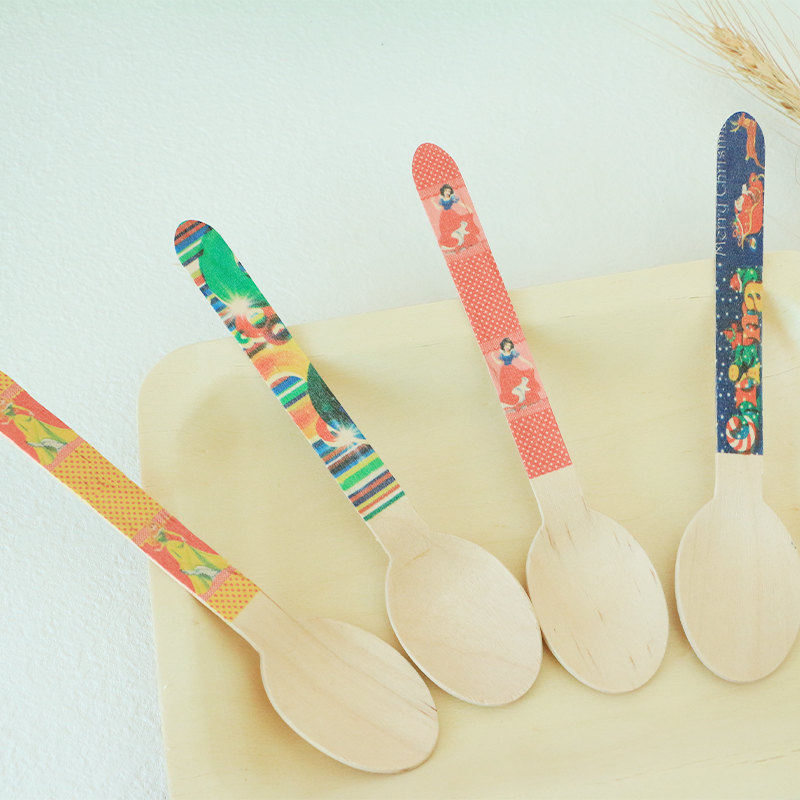
Customization on GW-20456 includes size, logo applied by laser or print, and packaging. Both logo methods act on the surface of the product:
- Laser marking alters the wood surface itself. If it is specified without reference to the finish requirement, the marking depth and the surrounding edge become a new, uncontrolled surface feature.
- Print marking adds a layer on top of the finished surface, which introduces a drying and adhesion question that does not exist on unbranded product.
The procurement rule is straightforward: specify the logo method and the surface requirement in the same clause. When branding is added later as a change order, the surface acceptance criterion that was agreed for the base product is no longer automatically valid for the branded version.
Heat Resistance and Food-Contact Validation
GW-20456 is specified as heat-resistant and suitable for hot and cold food. Heat performance in a wood product is not a standalone property; it is validated through food-contact compliance, because hot food contact is the condition under which migration limits apply.
The relevant document set for wooden tableware in this range includes:
- FDA 21 CFR 178.3800, tested under certificate R0723000394 issued by the National Reference Laboratory for Food Contact Material (Guangdong), also referencing GB 4806.12-2022 and GB 9685-2016.
- LFGB, certificate 7216006083-2 issued by TÜV SÜD China, scope: all wood and bamboo tableware.
For a buyer, the meaningful test is scope alignment: the certificate must cover the material and the product category being ordered, and it must be current at the time of the order. Certificate numbers, issuing bodies and validity dates should be recorded in the purchase specification, not filed informally, because they are the documents an EUDR or retailer compliance review will ask for.
Step-by-Step: Verifying Dimensions and Surface Finish Before You Commit
The following sequence is written for a buying team evaluating a wooden cutlery specification. Each step converts a supplier claim into an internal control point.
- Fix the length list against your formats. Take the six GW-20456 lengths — 180 mm, 170 mm, 160 mm, 140 mm, 110 mm, 95 mm — and map each one to a real service format and its packaging cavity. Length is decided by the meal and the wrap, not by preference.
- Write the surface requirement as an acceptance criterion. Restate "smooth surface, no burrs" as visual, tactile and batch-consistency conditions, and state the inspection method and sample basis in the purchase order.
- Lock the logo method into the same clause. Decide laser or print before sampling, so the branded surface is evaluated against the same criterion as the base product.
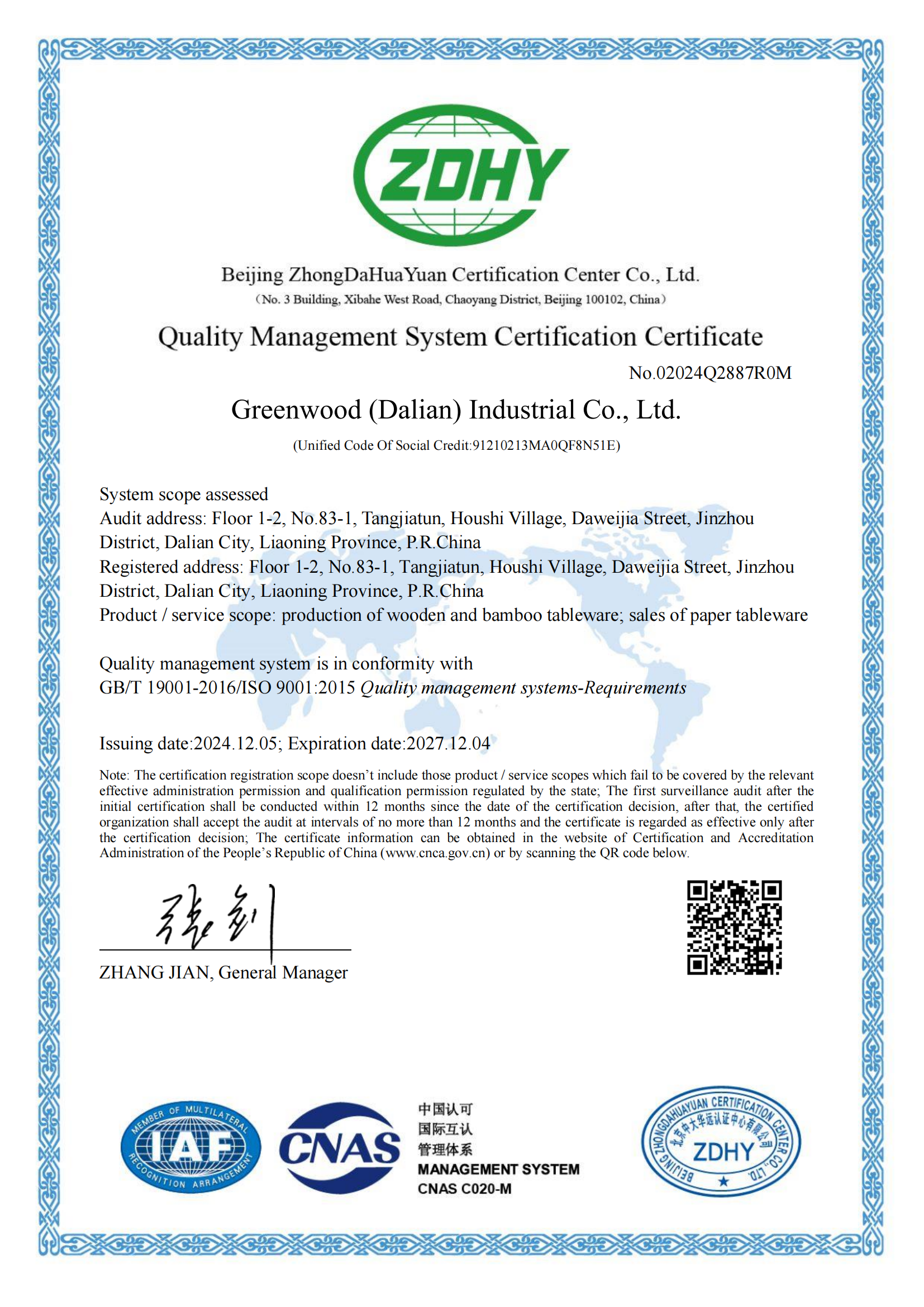
- Verify certificate scope, not just certificate presence. For wooden cutlery production control, two documents do the heavy lifting: FSC Chain of Custody SA-COC-013128, issued by Soil Association with a scope of wooden product and valid to 2028-04-02; and ISO 9001 certificate 02024E1883R0M, issued by Beijing ZhongDaHuaYuan Certification Center Co., Ltd under GB/T 19001-2016 / ISO 9001:2015, scope wooden product, valid to 2027-12-04. Check that the scope wording covers the items you are buying and that both are valid across your delivery window.
- Use third-party inspection at production. The capability record for customized wooden cutlery programs lists third-party inspection as the quality-control route, which gives the buyer an independent check on dimensional and surface criteria rather than a self-declared pass.
- Confirm MOQ, lead time and capacity against your replenishment cycle. The same capability record lists an MOQ of 100,000 pcs and a lead time of 20 days, with stated production capability of 10 million pieces per day.
- Re-verify on every reorder. Certification validity dates, wood source documentation and the agreed surface criterion should be re-checked at each annual or seasonal reorder, not only at first approval.
Use Cases: Where a Controlled Length Range Pays Off
The same six-length family supports very different operating models, and the reason is that each model puts a different parameter under pressure.
- Restaurant chains and hotels. Multiple menu formats run in parallel, which is exactly the situation where a single length is either too long for one format or too short for another. A six-length range allows one approved specification to serve all of them.
- Takeaway and delivery operators. Here the constraint is usually the packaging cavity and the wrap, not the meal. Length tolerance against the wrap is the value driver.
- Supermarkets and chain stores. Retail programs add branding and consumer handling to the equation, so the surface criterion and the logo method become the primary risk. A supermarket and chain-store program in Germany and the United States, running at an annual scale of USD 5 million across both B2B and B2C, ran for three years and resulted in the replacement of traditional products and a corresponding sales increase. That kind of program depends on batch-to-batch consistency of the branded surface.
- Airlines and catering. Individually wrapped and compact service formats place the tightest constraint on dimensions, and hot-food service places the tightest constraint on heat and food-contact documentation.
- Events, parties and camping. Volume is spiky and the failure mode is edge quality under fast handling, which again makes the "no burrs" criterion the operative one.
Comparison Table: Specification vs. Verification Route
The table below maps each GW-20456 specification point to the route a buyer can use to verify it. It is a verification matrix rather than a product comparison, because dimension and finish claims can only be checked against a document trail and an inspection event.
| Parameter | GW-20456 specification | Buyer verification route | Reference document |
|---|---|---|---|
| Available lengths | 180 / 170 / 160 / 140 / 110 / 95 mm, customizable | Physical measurement against purchase order; packaging fit test | GW-20456 product specification |
| Material | 100% natural wood (birch / poplar) | Specification review; FSC chain-of-custody documentation | GW-20456 specification; FSC SA-COC-013128 |
| Surface and edge | Smooth surface, no burrs | Visual and tactile inspection at goods-in; third-party inspection at production | GW-20456 specification; ISO 9001 QMS |
| Heat and cold use | Heat-resistant; suitable for hot and cold food | Food-contact certificate scope check for the ordered category | FDA 21 CFR 178.3800 report R0723000394; LFGB 7216006083-2 |
| Food safety | Food-grade, BPA-free, non-toxic | Certificate scope review; validity check across the delivery window | FDA 21 CFR 178.3800, GB 4806.12-2022, GB 9685-2016; LFGB |
| End of life | 100% biodegradable & compostable | Confirm claim wording against the applicable compostability standard for the destination market | GW-20456 specification; EN 13432 (EU claim basis) |
| Branding | Laser or print logo on product and packaging | Artwork approval plus branded sample sign-off against the surface criterion | Customization program record |
| Production control | Quality management system covering wooden product manufacturing | Certificate validity and scope check | ISO 9001 certificate 02024E1883R0M |
| Order parameters | MOQ 100,000 pcs; lead time 20 days; third-party inspection | Match to replenishment cycle and warehouse plan | Capability record |
How to read this table: for every row where the specification is a claim, there is a document or an inspection event that converts it into evidence. A supplier evaluation that stops at the left two columns is a catalogue review; the right two columns are what a purchase specification should contain.
FAQ
Which certifications validate production control for Greenwood wooden cutlery?
Production control for wooden cutlery is covered by two documents in particular. The FSC Chain of Custody certificate SA-COC-013128, issued by Soil Association, has a scope of wooden product; the FSC standard applied is the FSC Chain of Custody standard, with validity to 2028-04-02. The ISO 9001 certificate 02024E1883R0M, issued by Beijing ZhongDaHuaYuan Certification Center Co., Ltd under GB/T 19001-2016 / ISO 9001:2015, has a scope of wooden product and is valid to 2027-12-04. These are supplemented by food-contact and social-compliance documentation including BRCGS (certificate 10000305214-MSC-ACCREDIA-CHN, DNV, valid to 2027-05-02), FDA 21 CFR 178.3800 (report R0723000394), LFGB (7216006083-2, TÜV SÜD China), ISO 14001, ISO 45001, BSCI and Sedex.
Can GW-20456 be produced in custom lengths and with a custom logo?
Yes. GW-20456 is offered in six standard lengths — 180 mm, 170 mm, 160 mm, 140 mm, 110 mm and 95 mm — with customizable sizes available. Customization covers logo printing on both products and packaging by laser or print, customized shapes, new designs, and packaging design support. The customized wooden cutlery program is stated at a production capability of 10 million pieces per day, with third-party inspection as the quality-control route. Because laser and print marking act on the wood surface, the logo method should be specified together with the smooth-surface, no-burr requirement so that the branded item is evaluated against the same acceptance criterion as the unbranded item.
What order quantities and volumes apply to a wooden cutlery program?
The stated minimum order quantity for customized wooden cutlery programs is 100,000 pcs, with a lead time of 20 days and a stated production capability of 10 million pieces per day. Greenwood operates five major factories, runs an export ratio of 95%, and serves Europe, ANZ, Canada, USA, South America, the Middle East, Japan & Korea and Southeast Asia, with warehouses in Bangladesh, Ukraine and the United States. For buyers, the practical implication is that the MOQ and lead time should be tested against the replenishment cycle before the specification is approved, not after.
How can a buyer validate dimensions and surface finish before placing a bulk order?
Validation runs on three tracks. First, a physical sample compared against the written acceptance criteria — overall length, and the visual, tactile and batch-consistency conditions that define "smooth surface, no burrs". Second, a document check: confirm that the ISO 9001 certificate 02024E1883R0M and the FSC Chain of Custody certificate SA-COC-013128 are valid across your delivery window and that their scope wording covers the items ordered. Third, third-party inspection at production, which gives an independent confirmation of dimensional and surface criteria rather than a self-declared result. Branded versions should be sampled as branded versions, because the logo process changes the surface.
What is the lead time, and what support is available after the order?
The stated lead time is 20 days, with packaging design and logistics support listed as after-sales services. Because a cutlery program usually runs across several reorders and frequently across several markets, the two documents that should be re-checked at each cycle are the certificate validity dates — ISO 9001 to 2027-12-04 and FSC Chain of Custody to 2028-04-02 — and the wood source documentation supporting EUDR due diligence. Greenwood – Dalian Industrial Co.,ltd. provides the full specification and certificate file on request; a sample request or specification review is the normal first step before a bulk order.
Conclusion
Wooden cutlery sourcing gets decided by unglamorous parameters. GW-20456 covers six lengths — 180 mm, 170 mm, 160 mm, 140 mm, 110 mm and 95 mm — with customizable sizes, a stated smooth surface without burrs, heat resistance for hot and cold food, and 100% biodegradable and compostable material. What turns those claims into a workable purchase specification is the document layer: FSC Chain of Custody SA-COC-013128, ISO 9001 certificate 02024E1883R0M, and food-contact certification under FDA 21 CFR 178.3800 and LFGB.
For a buying team in evaluation, the sequence is short: fix the length list against the meal and the packaging, write the surface criterion as an acceptance test, specify the logo method at the same time, verify certificate scope and validity, and use third-party inspection at production. Each step converts a supplier statement into something your own quality team can audit.
Next step: request the GW-20456 specification sheet, certificate file and a branded and unbranded sample for dimensional and surface validation.
Greenwood – Dalian Industrial Co.,ltd. | woodencutlery.cn
Email: ireenwang@caregreenwood.com | WhatsApp: +86 138 4090 7153
Have Questions or Need More Details?
Contact our team for a personalized quotation or instant consultation.
Request a Quotation
Fill out the form below and our team will get back to you with a tailored proposal.
WhatsApp Direct Chat
Prefer to chat in real-time? Message us on WhatsApp for instant assistance & quick answers.
- Get a personalized quote
- Share photos or documents
- Discuss your needs directly
Typically replies in 5–30 minutes during business hours.