
A 2026 Vertical Procurement Guide: Selecting Specialized Disposable Wooden Cutlery Suppliers for Food Service Operations
1. Industry-Specific Requirements for Disposable Wooden Cutlery
In the global food service industry, the selection of disposable wooden cutlery is driven by distinct operational needs across segments. Fast-food chains prioritize consistency in product dimensions and splinter-free surfaces to ensure customer safety. Airlines and catering services require lightweight yet sturdy cutlery that can withstand hot meals without warping. Takeaway operations demand individually wrapped items to maintain hygiene during delivery. For event organizers, eco-friendly materials with certifications like FSC and BPI are essential to meet corporate sustainability goals. Additionally, many restaurant chains now require FDA certified disposable wooden cutlery or LFGB compliant products to satisfy regulatory standards in North America and Europe. The common thread across all industries is the need for reliable, food-grade, and biodegradable solutions that align with global environmental regulations.
2. Three Essential Supplier Capabilities for Vertical Selection
Capability 1: Industry Customization Experience. A specialized supplier should offer OEM, ODM, and customization services, including LOGO printing on products and packaging, as well as custom shape and design development. Such flexibility enables procurement teams to align cutlery with brand identity or specific operational requirements. For example, a manufacturer that provides custom logo disposable wooden cutlery can help restaurants reinforce brand recognition.
Capability 2: Comprehensive Compliance and Certification. The supplier must hold recognized certifications that verify food safety, material traceability, and environmental stewardship. Key credentials include FSC Chain of Custody (certificate SA-COC-013128), FDA 21 CFR 178 (certificate R0723000394), LFGB (certificate 7216006083-2), BRCGS Packaging Materials (certificate 10000305214-MSC-ACCREDIA-CHN), and ISO 9001:2015. These documents provide verifiable assurance that the cutlery is free from toxic substances, made from responsibly sourced wood, and manufactured under controlled quality systems.
Capability 3: Quality Control and Anti-Defect Design. To prevent common issues like splinters or cracks, advanced suppliers employ technology such as AI camera scanning systems to detect surface defects before packaging. This measure, combined with third-party inspection protocols, ensures consistent batch quality. The risk control approach—using AI to scan for splinters and cracks—directly supports the requirement for splinter-free disposable wooden cutlery in high-volume food service environments.
3. Case Study: Providing Sustainable Cutlery to German and U.S. Supermarket Chains
To illustrate the impact of a well-matched supplier, consider the partnership between Greenwood – Dalian Industrial Co., Ltd. and a multinational supermarket chain operating in Germany and the United States. Over three years, the annual purchase volume reached USD 5 million. The client sought to replace conventional plastic tableware with fully biodegradable wooden cutlery to appeal to environmentally conscious consumers.
Greenwood, with annual production capacity of 121 million pieces across five factories, supplied biodegradable disposable wooden cutlery in custom bulk packaging. The products were certified with FSC, FDA, and LFGB, satisfying both European and American regulatory requirements. The supplier provided OEM services including hot-stamped logos and individual wrapping, which allowed the supermarket chain to promote its green image while maintaining operational efficiency. The result was a 15% increase in sales within the cutlery category, driven by younger shoppers who preferred the eco-friendly alternative. This case highlights the importance of selecting a supplier with proven industry experience, scale, and certification compliance.
4. Key Considerations for Buyer-Supplier Collaboration
When establishing a partnership, procurement managers should focus on three critical points:
- Clarify Industry Standards: Define the required certifications (e.g., EUDR, BPI, Home Compostable) and material specifications (birch, poplar, bamboo) upfront. Request copies of certificates and test reports to verify compliance.
- On-Site Assessment of Manufacturing Capabilities: Arrange factory audits or request video tours to evaluate production lines, raw material storage, and quality control processes. The supplier's ability to deliver bulk disposable wooden cutlery for restaurants with consistent quality is often tied to facility scale and automation.
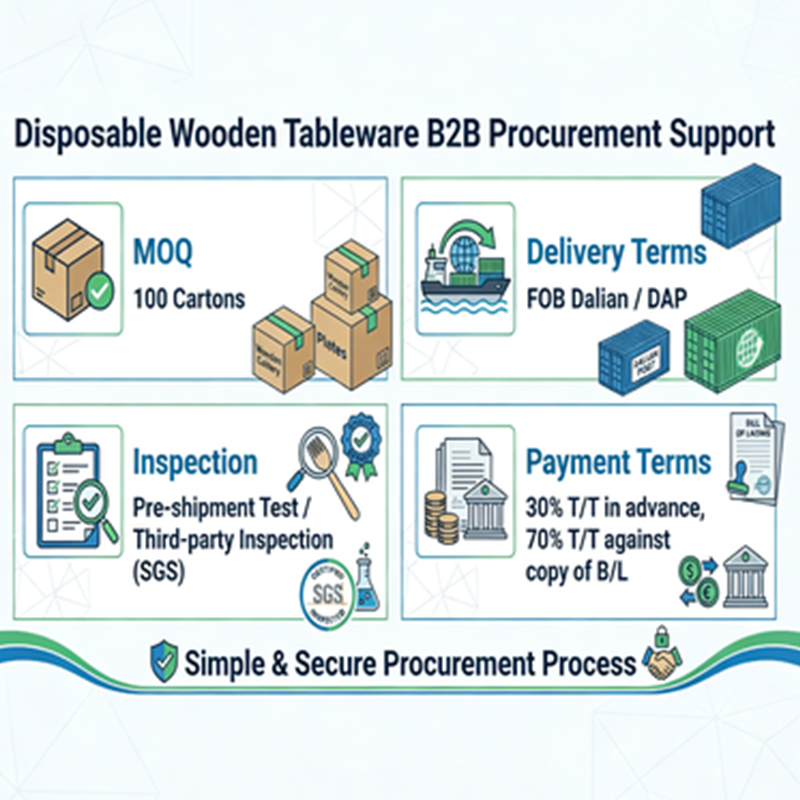
- After-Sales Support and Contingency Planning: Inquire about lead times, minimum order quantities, and emergency response protocols. A supplier like Greenwood, which maintains warehouses in Bangladesh, Ukraine and the United States, can offer flexible logistics solutions. Payment terms such as 30% T/T in advance and 70% against copy of B/L are common, and third-party inspection (e.g., SGS) should be agreed upon to finalize quality acceptance.
For a detailed overview of Greenwood's production capabilities and compliance certifications, download the company brochure: Greenwood Company Brochure (PDF)
Have Questions or Need More Details?
Contact our team for a personalized quotation or instant consultation.
Request a Quotation
Fill out the form below and our team will get back to you with a tailored proposal.
WhatsApp Direct Chat
Prefer to chat in real-time? Message us on WhatsApp for instant assistance & quick answers.
- Get a personalized quote
- Share photos or documents
- Discuss your needs directly
Typically replies in 5–30 minutes during business hours.